Helping the southern ground hornbill
NEST BOXES ARE A CRITICAL CONSERVATION TOOL
Baobab Ridge takes its conservation role very seriously and contributes directly to a number of dedicated programmes. One of these is the Associated Private Nature Reserves (APNR) Southern Ground Hornbill Project, which is based here in the Greater Kruger National Park.
The shortage of good nesting sites has become problematic for this endangered bird - the largest of the hornbill species that's largely terrestrial but typically nests in natural tree cavities. So the APNR Southern Ground Hornbill Project has created artificial nests for the birds to use and we have just sponsored one of these to help grow the local population of these impressive birds.
Ground hornbills lay two eggs, but only one chick (usually the older, stronger one) survives. Because of their endangered status, the project researchers remove one egg from each nest box and incubate it, rearing the chicks they rescue this way together and releasing them into areas where ground hornbills have disappeared or are in decline. This helps to repopulate areas where these amazing birds have become locally extinct.
The project's focus on the nest boxes has increased breeding success by an average of 14% which is excellent news for the future of the southern ground hornbill and success for the APNR project and its work that's aimed at slowing and reversing the decline of the species.
The APNR Southern Ground Hornbill Project works closely with the FitzPatrick Institute of African Ornithology which has been investigating the birds' habitat use, reproductive success and behaviour for the past 20 years.
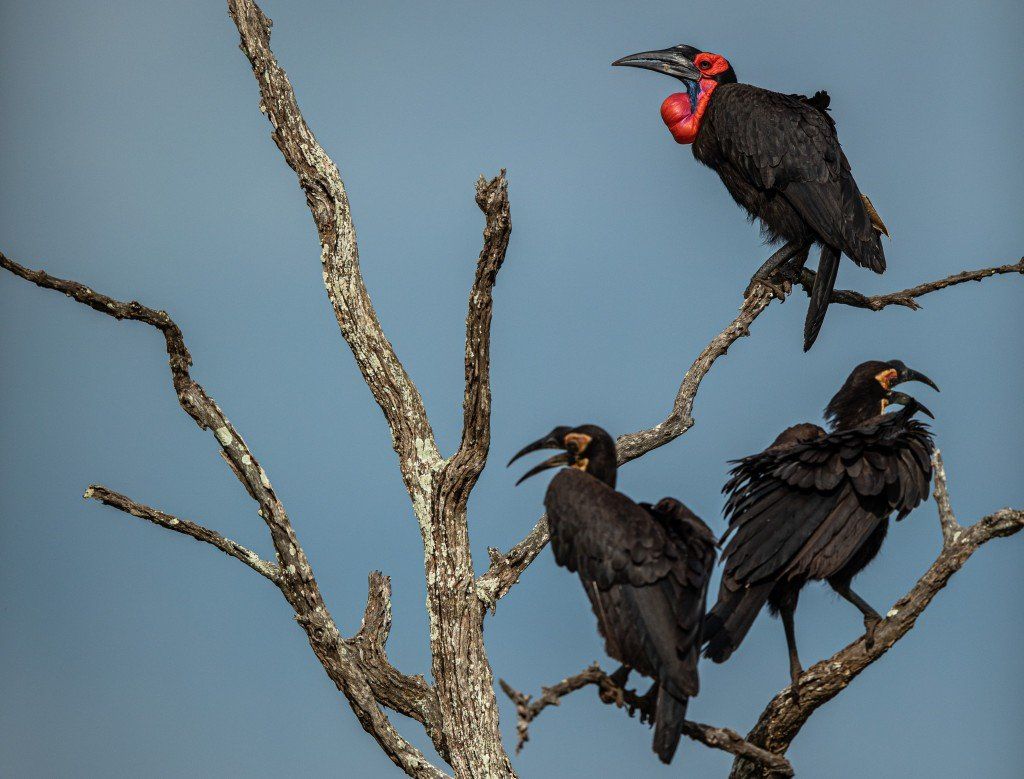
These large and odd-looking birds' distinctive black plumage, bright red facial skin, beautiful big eyes and enormous beaks make them stand out as one of the most striking species in Southern Africa. Their scientific name - Bucorvis leadbeateri - is derived from the latin word for large, crow-like bird and the Victorian naturalist who first described them, Benjamin Leadbeater.
The southern ground hornbill is the world's largest co-operatively breeding bird and can get as large as 1m tall, weighing in at up to 4,5kg. You'll usually see groups of up to five individuals but larger groups of up to 12 have been recorded. Groups have their own territories or home ranges that can be as large as 250 square kilometres. In each group there is an alpha pair assisted by severl "helpers" - usually male offspring from previous years. Female birds tend to be chased out at a young age so as not to compete with the alpha female. They can live for up to 70 years!
Their distinctive facial colouration provides an easy way to sex the birds. Males have throats that are completely red while the females have a patch of blue just below the bill. Juveniles don't fully develop their red throats until they are eight years old. Initially they have a greyish yellow throat for up to two years of age before slowly transitioning to the adult colouration.
Ground hornbills eat mostly invertebrates but they also target snakes, lizards, tortoises, small mammals and other birds. Their huge bill is incredibly strong and sharp and can easily pierce the carapace of tortoises. In spite of spending most of their time on the ground, they are good flyers and roost in trees.
Images: APNR Southern Ground Hornbill Project